
Surah Al-Baqarah Explained: Meaning, Tafsir, Translation & Lessons
Surah Al-Baqarah Explained is a guide to the second and longest chapter of the Quran. With 286 verses, Al-Baqarah covers some of the most important foundations of Islamic belief, worship, morality, family life, financial dealings, and guidance for the Muslim community.
The name Al-Baqarah (البقرة) means “The Cow.” The Surah takes its name from the story of the cow mentioned in verses 67–73, involving Prophet Musa (Moses) and the Children of Israel.
For Muslims seeking to understand the Quran, Surah Al-Baqarah is especially important because it teaches that true guidance requires faith, worship, obedience to Allah, patience, and action.
In this guide, we will explore its meaning, major themes, important passages, lessons, and significance in a Muslim’s life.
Surah Al-Baqarah: Quick Facts
Surah number: 2
Number of verses: 286
Arabic name: البقرة
English meaning: The Cow
Place of revelation: Madinah
Classification: Madani Surah
Juz: Spans Juz 1, 2 and part of Juz 3
Previous Surah: Al-Fatihah
Next Surah: Aal ‘Imran
Surah Al-Baqarah begins immediately after Al-Fatihah. In Al-Fatihah, believers ask Allah:
“Guide us to the Straight Path.”
Al-Baqarah then opens by describing the Quran as guidance for those who are conscious of Allah.
How Surah Al-Baqarah Begins
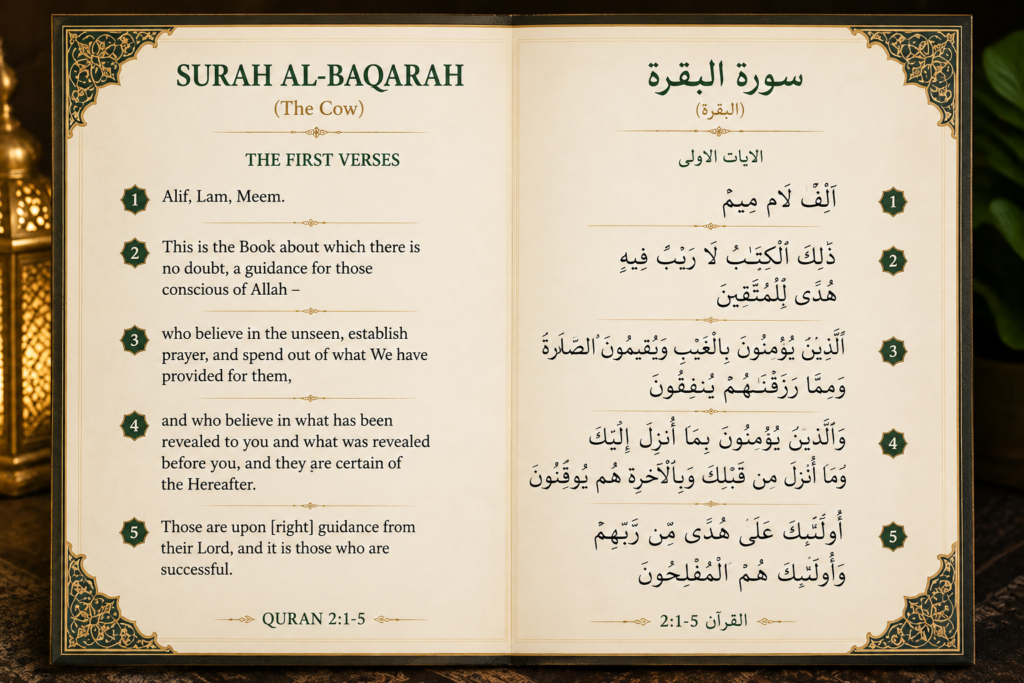
The Surah begins:
الم
Alif, Lam, Meem.
These letters are among the huruf al-muqatta’at — the disconnected letters appearing at the beginning of several chapters of the Quran.
Their complete meaning is known to Allah.
The following verses introduce one of the central messages of the Surah:
ذَٰلِكَ الْكِتَابُ لَا رَيْبَ ۛ فِيهِ ۛ هُدًى لِّلْمُتَّقِينَ
Meaning:
“This is the Book about which there is no doubt, a guidance for those conscious of Allah.”
— Quran 2:2
From its beginning, Al-Baqarah establishes the Quran as a source of guidance.
Three Types of People
At the beginning of Surah Al-Baqarah, Allah describes three broad categories of people.
1. The Believers
The believers have faith in the unseen, establish prayer, spend from what Allah has provided them, believe in revelation, and have certainty in the Hereafter.
Faith is therefore not presented merely as something a person says. It influences worship, behavior, and priorities.
2. The Disbelievers
The Surah then describes those who persistently reject the truth despite receiving guidance.
3. The Hypocrites
A longer passage discusses hypocrisy: people may outwardly claim faith while concealing disbelief.
This teaches Muslims the importance of sincerity. Islam concerns not only outward appearances but also what exists within the heart.
The Story of Prophet Adam
Surah Al-Baqarah recounts important parts of the story of Adam (peace be upon him).
Allah informed the angels that He would place a successor on Earth.
Allah taught Adam the names and demonstrated the knowledge He had given him.
The angels obeyed Allah when commanded to prostrate before Adam, but Iblis refused out of arrogance.
Adam and his wife were allowed to live in Paradise but were commanded not to approach a particular tree. Satan caused them to slip, after which they were sent to Earth.
Yet the story does not end with the mistake.
Adam received words from his Lord and Allah accepted his repentance.
Lesson from the Story of Adam
Human beings can make mistakes, but the door of sincere repentance remains open.
The story also warns against arrogance, because arrogance was at the heart of Iblis’s refusal to obey Allah.
The Children of Israel
A substantial portion of Surah Al-Baqarah discusses the Children of Israel.
Allah reminds them of blessings they received and of the prophets and revelation sent to them. The Surah also recounts instances in which some among them broke covenants or failed to obey divine commands.
These accounts are not simply historical narratives. They provide lessons about gratitude, obedience, sincerity, and the danger of knowing the truth without acting upon it.
Why Is It Called “The Cow”?
The name Al-Baqarah comes from the story found in verses 67–73.
Prophet Musa told his people that Allah commanded them to slaughter a cow.
Rather than immediately carrying out the command, they repeatedly asked questions concerning its characteristics.
Eventually, they carried out the command.
The account teaches an important lesson about obedience to Allah and warns against unnecessarily making religious obligations more difficult.
Prophet Ibrahim and the Ka’bah
Surah Al-Baqarah contains important passages concerning Prophet Ibrahim (Abraham) and Prophet Isma’il (Ishmael), peace be upon them.
Allah says:
وَإِذْ يَرْفَعُ إِبْرَاهِيمُ الْقَوَاعِدَ مِنَ الْبَيْتِ وَإِسْمَاعِيلُ
Meaning:
“And when Abraham was raising the foundations of the House and Ishmael…”
— Quran 2:127
As they raised the foundations of the Ka’bah, they prayed for Allah to accept their work.
This provides a beautiful lesson: even while performing a great act of worship, a believer should remain humble and ask Allah for acceptance.
The Change of the Qiblah
Another major event discussed in Surah Al-Baqarah is the change of the direction of prayer.
Muslims initially prayed toward Jerusalem. Allah later commanded Muslims to face Al-Masjid Al-Haram in Makkah, where the Ka’bah is located.
The Qiblah remains the direction Muslims face during Salah throughout the world.
The passage teaches obedience and emphasizes the distinct identity and unity of the Muslim community.
Patience and Prayer
Surah Al-Baqarah repeatedly teaches Muslims to seek Allah’s help through patience and prayer.
Allah says:
يَا أَيُّهَا الَّذِينَ آمَنُوا اسْتَعِينُوا بِالصَّبْرِ وَالصَّلَاةِ
Meaning:
“O you who have believed, seek help through patience and prayer.”
— Quran 2:153
A Muslim will experience difficulties, uncertainty, loss, and trials.
The Quran teaches believers not to abandon their faith during hardship, but to turn toward Allah.
Trials Are Part of Life
Allah explains that believers will be tested with fear, hunger, loss of wealth, lives, and fruits.
But glad tidings are given to those who remain patient.
When calamity reaches them, they say:
إِنَّا لِلَّهِ وَإِنَّا إِلَيْهِ رَاجِعُونَ
“Indeed we belong to Allah, and indeed to Him we will return.”
— Quran 2:156
This phrase reminds believers that everything ultimately belongs to Allah and that every person will return to Him.
Righteousness Is More Than Appearance
One of the important teachings of Surah Al-Baqarah appears in verse 177.
The verse explains that righteousness is not merely about turning toward a particular direction.
True righteousness includes faith in Allah, the Last Day, the angels, revelation and the prophets, as well as generosity, prayer, charity, fulfilling promises, and patience.
This demonstrates an essential Quranic principle:
True faith should produce righteous action.
Fasting in Ramadan
Surah Al-Baqarah contains the Quranic command concerning fasting during Ramadan.
Allah says:
يَا أَيُّهَا الَّذِينَ آمَنُوا كُتِبَ عَلَيْكُمُ الصِّيَامُ
Meaning:
“O you who have believed, fasting has been prescribed for you…”
— Quran 2:183
The verse explains that fasting was also prescribed for people before the Muslim community and states its purpose:
“…so that you may become mindful of Allah.”
Fasting is therefore not simply abstaining from food and drink. It is an act of worship intended to strengthen taqwa — consciousness of Allah.
The Quran and Ramadan
A few verses later, Allah explains the special connection between Ramadan and the Quran:
“The month of Ramadan is that in which the Quran was revealed as guidance for humanity…”
— Quran 2:185
This is why Muslims give particular attention to reading, reciting, and studying the Quran during Ramadan.
Allah Is Near
Among the most comforting passages of Al-Baqarah is verse 186.
Allah says:
وَإِذَا سَأَلَكَ عِبَادِي عَنِّي فَإِنِّي قَرِيبٌ
Meaning:
“When My servants ask you about Me, indeed I am near.”
— Quran 2:186
Allah then states that He responds to the call of the one who calls upon Him.
This verse teaches Muslims to make Dua directly to Allah with sincerity and trust.
Hajj and Umrah
Surah Al-Baqarah also contains guidance concerning Hajj and Umrah.
It discusses completing these acts of worship for Allah and provides instructions connected to the pilgrimage.
The passages remind Muslims that acts of worship should be performed sincerely for Allah rather than for reputation or worldly recognition.
Marriage and Family Life
Surah Al-Baqarah contains several teachings concerning family matters, including marriage, divorce, waiting periods, breastfeeding, and financial responsibilities.
These passages demonstrate that Islamic guidance is not restricted to prayer and fasting.
The Quran also provides principles governing relationships, responsibilities, justice, and the protection of people’s rights.
Spending in the Way of Allah
Charity and generosity are recurring themes throughout Al-Baqarah.
One of its most memorable examples compares sincere spending for Allah’s sake to a grain that produces seven ears, each containing one hundred grains.
The lesson is that Allah can multiply the reward of sincere charity enormously.
However, the Surah also warns believers not to destroy the reward of charity through reminders of generosity or by hurting the recipient.
Giving should be sincere and respectful.
The Prohibition of Riba
Surah Al-Baqarah contains some of the Quran’s strongest warnings concerning riba, commonly translated as usury or interest.
Allah distinguishes lawful trade from riba and commands believers to abandon what remains of it.
These verses form an important foundation for Islamic teachings concerning financial ethics.
Muslims are encouraged to seek lawful earnings, conduct business honestly, avoid exploitation, and remember that wealth is ultimately a trust from Allah.
The Longest Verse in the Quran
Verse 2:282 is the longest verse in the entire Quran.
It concerns debts and financial transactions.
The verse instructs believers to record deferred debts and establishes principles concerning documentation and witnesses.
This is significant because it demonstrates the importance Islam gives to clarity and fairness in financial dealings.
Good intentions do not eliminate the need for responsible documentation.
Ayat Al-Kursi – The Verse of the Throne
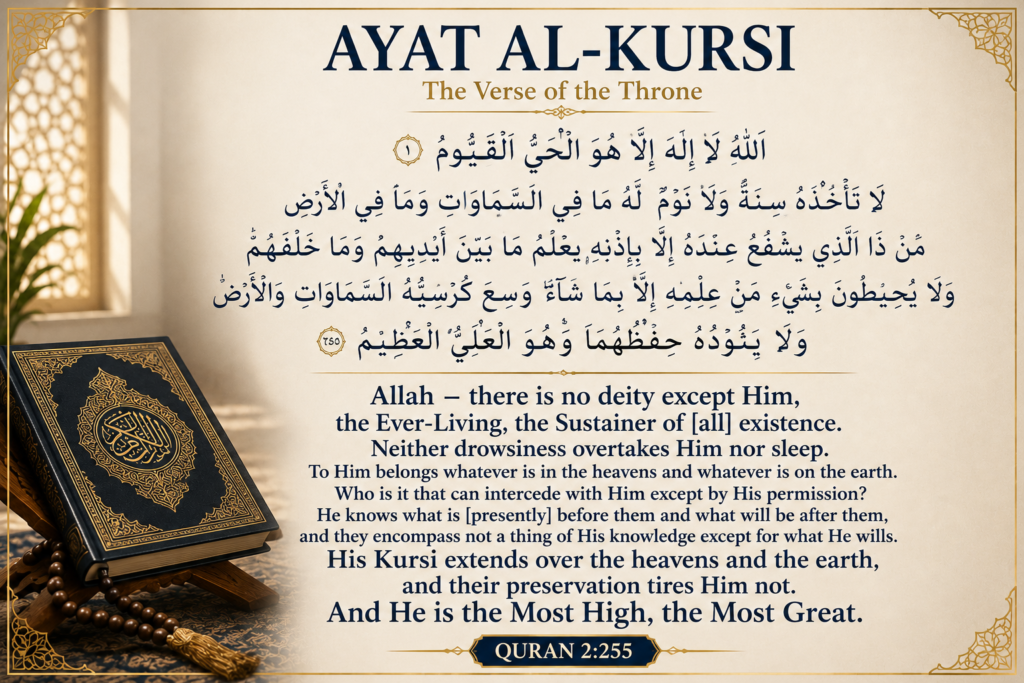
One of the most famous verses in the entire Quran appears in Surah Al-Baqarah.
It is Ayat Al-Kursi, verse 255.
It begins:
اللَّهُ لَا إِلَٰهَ إِلَّا هُوَ الْحَيُّ الْقَيُّومُ
Meaning:
“Allah—there is no deity except Him, the Ever-Living, the Sustainer of all existence.”
— Quran 2:255
Ayat Al-Kursi describes Allah’s perfect life, knowledge, authority and power.
Neither drowsiness nor sleep overtakes Him. Everything in the heavens and Earth belongs to Him, and His knowledge encompasses His creation.
It is one of the greatest verses for understanding the majesty and absolute sovereignty of Allah.
There Is No Compulsion in Religion
Immediately after Ayat Al-Kursi comes another well-known verse:
لَا إِكْرَاهَ فِي الدِّينِ
Meaning:
“There is no compulsion in religion.”
— Quran 2:256
The verse continues by stating that truth has become distinct from error.
Faith cannot be reduced to forced outward words. Genuine belief involves conviction.
Allah Does Not Burden a Soul Beyond Its Capacity
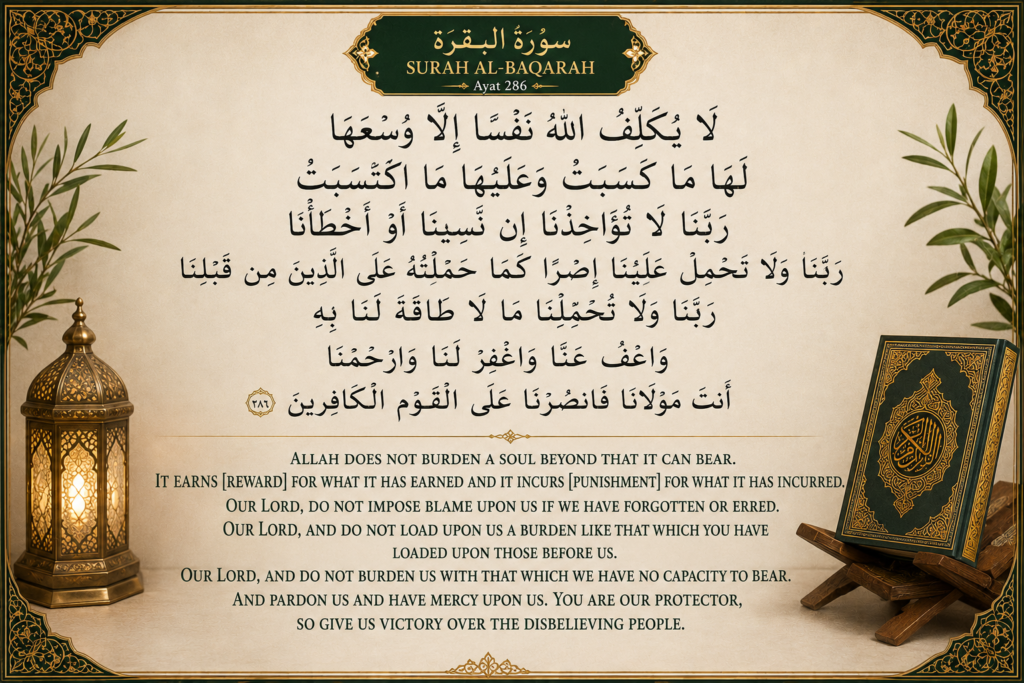
The final verse of Surah Al-Baqarah contains one of the Quran’s most comforting teachings:
لَا يُكَلِّفُ اللَّهُ نَفْسًا إِلَّا وُسْعَهَا
Meaning:
“Allah does not burden a soul beyond what it can bear.”
— Quran 2:286
The verse concludes with a beautiful supplication asking Allah for forgiveness, mercy, and help.
It reminds believers to turn to Allah when facing difficulties and responsibilities.
The Last Two Verses of Surah Al-Baqarah
Verses 285 and 286 conclude the Surah with declarations of faith and Dua.
The Messenger believes in what was revealed to him from his Lord, as do the believers.
They affirm belief in:
- Allah
- His angels
- His books
- His messengers
The Surah then ends with prayers asking Allah not to hold believers accountable for forgetfulness or mistakes, not to place unbearable burdens upon them, and to grant forgiveness and mercy.
Virtues of Surah Al-Baqarah
Authentic hadith describe special virtues connected with Surah Al-Baqarah.
The Prophet Muhammad ﷺ taught Muslims not to turn their homes into graves and stated that Satan flees from a house in which Surah Al-Baqarah is recited. This is reported in Sahih Muslim.
Another authentic narration states that whoever recites the last two verses of Surah Al-Baqarah at night, they will suffice for him. This is reported in Sahih al-Bukhari and Sahih Muslim.
These narrations demonstrate the special position this Surah holds in the life of a Muslim.
Major Lessons from Surah Al-Baqarah
Surah Al-Baqarah covers an extraordinary range of subjects, but several major lessons connect the entire chapter.
1. Guidance Requires Action
Knowing Allah’s commands is not enough. A believer should strive to follow them.
2. Obedience to Allah Comes First
The stories throughout the Surah repeatedly demonstrate the importance of submitting to Allah’s guidance.
3. Faith and Daily Life Are Connected
Islamic guidance encompasses worship, family, money, charity, contracts, fasting, pilgrimage, and personal behavior.
4. Trials Require Patience
Difficulties are part of worldly life. Believers are taught to seek help through patience and Salah.
5. Repentance Is Always Important
The story of Adam demonstrates that human beings make mistakes, but sincere repentance can bring them back to Allah.
6. Wealth Is a Responsibility
Muslims should earn lawfully, avoid exploitation, document debts, give charity, and use wealth responsibly.
7. Allah Knows Everything
Ayat Al-Kursi reminds believers of Allah’s complete knowledge, power, and authority.
8. Dua Is Essential
Allah tells His servants that He is near and responds to those who call upon Him.
How Muslims Can Apply Surah Al-Baqarah Today
Surah Al-Baqarah is not simply a chapter to finish reading. Its teachings can influence everyday life.
A Muslim can apply its guidance by:
- Establishing the five daily prayers.
- Reading and studying the Quran regularly.
- Being patient during hardship.
- Making sincere Dua.
- Fasting Ramadan faithfully.
- Giving charity without seeking praise.
- Dealing honestly with money and debts.
- Avoiding riba.
- Treating family members justly.
- Repenting after mistakes.
- Strengthening belief in Allah and the Hereafter.
- Reciting and reflecting upon Ayat Al-Kursi.
- Learning the final verses of Al-Baqarah.
The purpose of learning the Quran should ultimately be to become closer to Allah and to live according to His guidance.
Conclusion
Surah Al-Baqarah Explained reveals why this chapter occupies such an important place in the Quran.
Across its 286 verses, Surah Al-Baqarah moves from faith and the stories of earlier communities to prayer, fasting, Hajj, charity, family responsibilities, financial ethics, patience, repentance, and reliance upon Allah.
It contains Ayat Al-Kursi, the Quran’s longest verse concerning debts, the verses prescribing Ramadan fasting, and the powerful final supplications of verses 285–286.
For someone studying Islam, Al-Baqarah teaches an essential principle: guidance is not merely something to know. It is something to believe, practice, and carry into everyday life.
After Surah Al-Baqarah, the Quran continues with Surah Aal ‘Imran (Chapter 3), which develops further themes of faith, revelation, steadfastness, and the stories of the family of ‘Imran.