
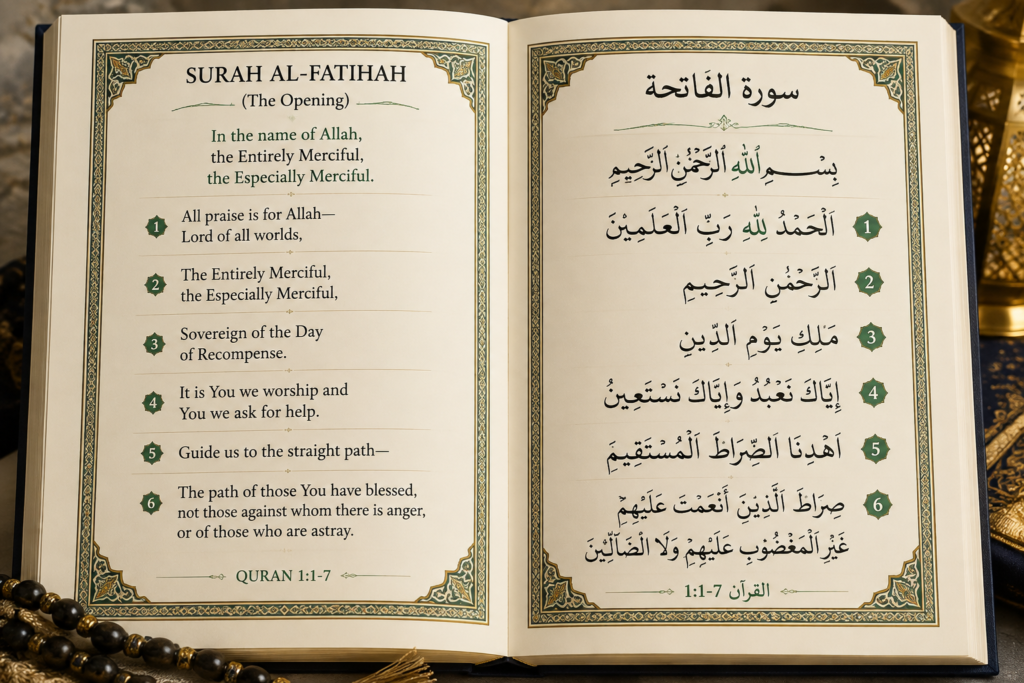
Surah Al-Fatihah Explained is a complete guide to the opening chapter of the Quran, one of the most important chapters for every Muslim.
Its seven short verses contain some of the central themes of Islam: knowing Allah, praising Him, recognizing His mercy, believing in the Day of Judgment, worshipping Him alone, relying upon Him, and asking Him for guidance.
Al-Fatihah is also inseparable from the Muslim prayer. A Muslim returns to its words throughout the day, making it far more than an introduction to the Quran.
For someone beginning their journey with the Quran, understanding Al-Fatihah is therefore one of the best places to start.
In this guide, we will explore Surah Al-Fatihah verse by verse, including its Arabic text, transliteration, English meaning, key themes, importance in Salah, and practical lessons for everyday life.
Surah Al-Fatihah: Quick Facts
Surah number: 1
Number of verses: 7
Arabic name: الفاتحة
English meaning of the name: The Opening
Common names: Al-Fatihah, Fatihat al-Kitab, Umm al-Quran / Umm al-Kitab
Central themes: Praise of Allah, mercy, judgment, worship, reliance upon Allah, and guidance.
The Prophet Muhammad ﷺ also described Al-Fatihah as the seven repeatedly recited verses and spoke of its exceptional status in the Quran.
What Does “Al-Fatihah” Mean?
Al-Fatihah means “The Opening.”
It is an appropriate name because this Surah opens the Quran and introduces themes that appear throughout the rest of Allah’s Book.
Al-Fatihah begins by teaching us about Allah.
It then teaches us about our relationship with Him.
Finally, it teaches us what we should ask Him for.
The Surah therefore moves beautifully from knowledge of Allah, to worship of Allah, to a prayer for guidance from Allah.
Why Is Surah Al-Fatihah So Important?
Al-Fatihah occupies a unique position in Islam.
The Prophet Muhammad ﷺ described it as an exceptionally great Surah of the Quran.
It also has a central place in Salah.
The Prophet ﷺ taught:
“There is no prayer for the one who does not recite the Opening of the Book.”
This is one reason learning Al-Fatihah is such an important priority for new Muslims.
But its importance goes beyond memorization.
A remarkable hadith recorded in Sahih Muslim describes Al-Fatihah as an intimate exchange between Allah and His servant.
When the servant praises Allah, Allah responds to that praise.
When the servant declares worship and dependence upon Him, Allah acknowledges what is between Him and His servant.
And when the servant asks for guidance, Allah says that the request is for His servant.
This transforms the way we can think about Al-Fatihah in prayer.
You are not simply repeating memorized words.
You are speaking to Allah.
Surah Al-Fatihah Verse by Verse
Verse 1 — Bismillah
Arabic
بِسْمِ اللَّهِ الرَّحْمَٰنِ الرَّحِيمِ
Transliteration
Bismillahir-Rahmanir-Raheem
Meaning
In the name of Allah, the Most Compassionate, the Most Merciful.
Explanation
The Surah begins with the name of Allah and immediately introduces two names connected with His mercy: Ar-Rahman and Ar-Raheem.
This establishes an important foundation.
The believer’s relationship with Allah is not built only upon fear of judgment. It also rests upon hope, love, gratitude, and recognition of His immense mercy.
Beginning with Bismillah also teaches Muslims to connect their actions with Allah.
Instead of living independently of their Creator, believers seek His blessing, remember Him, and recognize their dependence upon Him.
Lesson
Begin your actions by remembering Allah and never despair of His mercy.
Verse 2 — All Praise Belongs to Allah
Arabic
الْحَمْدُ لِلَّهِ رَبِّ الْعَالَمِينَ
Transliteration
Alhamdu lillahi Rabbil-‘alamin
Meaning
All praise is for Allah, Lord of all worlds.
Explanation
The word Alhamdulillah expresses praise and gratitude to Allah.
Allah is then described as Rabb al-‘Alamin — Lord of all worlds.
The Arabic word Rabb carries rich meanings connected with lordship, ownership, care, nurturing, and sustaining.
Allah is therefore not a distant Creator who created the universe and abandoned it.
He continuously sustains His creation.
And He is not merely the Lord of one nation or group.
He is the Lord of all worlds and all creation.
This verse trains the believer to see blessings differently.
Health, knowledge, family, food, opportunities, guidance, and even the ability to worship are ultimately blessings from Allah.
Lesson
Develop the habit of gratitude.
Instead of focusing only on what you lack, regularly remember what Allah has already given you.
Verse 3 — The Most Compassionate, the Most Merciful
Arabic
الرَّحْمَٰنِ الرَّحِيمِ
Transliteration
Ar-Rahmanir-Raheem
Meaning
The Most Compassionate, the Most Merciful.
Explanation
Allah’s mercy is emphasized again immediately after His lordship.
This repetition is significant.
Allah is powerful and sovereign, but His relationship with His creation is also characterized by immense mercy.
For someone who has sinned, made mistakes, or feels spiritually distant, this verse contains enormous hope.
Islam does not teach that a person must be flawless before returning to Allah.
Rather, repentance itself is part of the believer’s relationship with Him.
Lesson
Never allow your mistakes to convince you that returning to Allah is pointless.
Recognize your mistakes, repent sincerely, and continue moving toward Him.
Verse 4 — Master of the Day of Judgment
Arabic
مَالِكِ يَوْمِ الدِّينِ
Transliteration
Maliki Yawmid-Din
Meaning
Master of the Day of Judgment.
Explanation
After reminding us of Allah’s mercy, Al-Fatihah reminds us of accountability.
Islam balances hope and responsibility.
Allah is merciful, but human actions still matter.
The Day of Judgment is the day when people will return to Allah and be held accountable for what they did in this life.
Remembering the Hereafter changes the way a believer views everyday choices.
A good action that nobody notices is still known to Allah.
An injustice hidden from other people is still known to Allah.
A private act of worship is known to Allah.
Nothing is ultimately lost.
Lesson
Live with accountability even when nobody else is watching.
Verse 5 — You Alone We Worship
Arabic
إِيَّاكَ نَعْبُدُ وَإِيَّاكَ نَسْتَعِينُ
Transliteration
Iyyaka na’budu wa iyyaka nasta’in
Meaning
You alone we worship, and You alone we ask for help.
Explanation
This verse stands at the heart of Al-Fatihah.
The first half of the Surah describes Allah.
Now the servant responds.
You alone we worship.
This expresses Tawhid — directing worship to Allah alone.
Prayer, ultimate devotion, and acts of worship belong to Him.
Then comes:
You alone we ask for help.
The believer worships Allah while recognizing that they cannot succeed without His assistance.
This creates a powerful balance between effort and reliance.
Islam does not teach us to sit passively and expect everything to happen.
We make effort.
We plan.
We work.
But our hearts ultimately rely upon Allah.
Lesson
Work hard, but do not make your heart dependent entirely upon your own abilities.
Ask Allah for help.
Verse 6 — Guide Us to the Straight Path
Arabic
اهْدِنَا الصِّرَاطَ الْمُسْتَقِيمَ
Transliteration
Ihdinas-Siratal-Mustaqim
Meaning
Guide us to the Straight Path.
Explanation
After praising Allah and declaring our worship of Him, we finally make our central request:
Guidance.
This is profound.
A Muslim who already believes still asks Allah for guidance repeatedly throughout the day.
Why?
Because guidance is not merely discovering Islam once.
We need guidance to understand what is right.
We need guidance to choose what is right.
We need guidance to remain firm upon what is right.
And we need guidance when new difficulties and decisions appear.
The believer never reaches a point where they no longer need Allah’s guidance.
Lesson
Ask Allah for guidance not only during major crises, but every day.
Verse 7 — The Path of Those Favored by Allah
Arabic
صِرَاطَ الَّذِينَ أَنْعَمْتَ عَلَيْهِمْ غَيْرِ الْمَغْضُوبِ عَلَيْهِمْ وَلَا الضَّالِّينَ
Transliteration
Siratal-ladhina an’amta ‘alayhim, ghayril-maghdubi ‘alayhim wa lad-dallin
Meaning
The path of those You have blessed—not those who earned displeasure or those who went astray.
Explanation
The final verse explains the guidance requested in the previous verse.
We are not asking for an abstract philosophy.
We are asking Allah to guide us along the path of those who received His favor.
The Quran elsewhere describes those favored by Allah among the prophets, the truthful, the martyrs, and the righteous.
The verse also teaches that deviation can happen in different ways.
A person may know truth but fail to follow it.
Another person may act sincerely but without correct guidance.
The believer therefore needs both:
correct knowledge and righteous action.
Lesson
Do not seek knowledge without putting it into practice, and do not practice religion without seeking sound knowledge.
The Powerful Dialogue Hidden Inside Al-Fatihah
One of the most beautiful authentic teachings concerning Al-Fatihah comes from a hadith qudsi recorded in Sahih Muslim.
Allah describes the prayer as being divided between Himself and His servant.
When the servant says:
“All praise is for Allah, Lord of all worlds,”
Allah says that His servant has praised Him.
When the servant mentions Allah’s mercy, Allah acknowledges the servant’s praise.
When the servant says:
“Master of the Day of Judgment,”
Allah acknowledges that the servant has glorified Him.
Then the believer says:
“You alone we worship, and You alone we ask for help.”
Allah says that this is between Him and His servant.
Finally, when the servant asks:
“Guide us to the Straight Path…”
Allah declares that this is for His servant and that the servant will receive what they ask for.
Remembering this hadith can completely change the experience of reciting Al-Fatihah.
Salah becomes a conversation rather than a mechanical routine.
The Story and Revelation of Surah Al-Fatihah
People often search online for “the story of Surah Al-Fatihah.”
Here it is important to be careful.
There is no need to invent a dramatic story for every Surah.
Al-Fatihah is generally treated in traditional scholarship as an early Surah associated with the Makkan period, although scholars have discussed details concerning its revelation.
What is certain and more important is its role within the Quran and Muslim worship.
Its message introduces the believer to Allah and summarizes fundamental elements of the relationship between Creator and servant.
It moves through:
Praise → Mercy → Judgment → Worship → Reliance → Guidance.
That structure itself is one of the keys to understanding the Surah.
Other Names of Surah Al-Fatihah
Islamic sources and scholarship refer to Al-Fatihah by several names.
Al-Fatihah
The Opening.
It opens the Quran.
Fatihat al-Kitab
The Opening of the Book.
Umm al-Quran / Umm al-Kitab
Often translated as Mother of the Quran or Mother of the Book, indicating its foundational importance.
As-Sab’ al-Mathani
The Seven Oft-Repeated Verses.
This description reflects its seven verses and repeated recitation.
These names show how central this short Surah is to Islamic worship and Quranic understanding.
Surah Al-Fatihah and Salah
For new Muslims, this section is especially important.
Al-Fatihah is not simply recommended reading before moving on to other Surahs.
It occupies a fundamental position in Salah.
The Prophet Muhammad ﷺ taught that prayer without the Opening of the Book is not complete in the required sense.
Because of this, learning Al-Fatihah should be one of the first Quran-learning goals for someone beginning to pray.
However, beginners should not become overwhelmed.
Arabic pronunciation develops with practice.
Listen carefully.
Repeat slowly.
Learn one verse at a time.
And learn the meaning alongside the Arabic.
When you understand what you are saying, your Salah can gradually become much more conscious and meaningful.
How to Memorize Surah Al-Fatihah
Step 1 — Listen
Choose a clear Quran reciter and listen to one verse repeatedly.
Step 2 — Repeat
Repeat the verse aloud several times.
Do not rush to the next verse until the first feels comfortable.
Step 3 — Read the Meaning
Understand what the verse means.
Meaning makes memorization easier and transforms recitation from sounds into worship.
Step 4 — Connect the Verses
Once you know two verses separately, recite them together.
Continue adding verses gradually.
Step 5 — Practice in Salah
Once you are able, practicing Al-Fatihah regularly in prayer helps reinforce memorization.
Step 6 — Improve Pronunciation Gradually
If possible, learn from someone who can correctly recite Quranic Arabic.
Do not let fear of imperfect pronunciation stop you from learning.
Progress matters.
Major Themes of Surah Al-Fatihah
Al-Fatihah can be understood through several major themes.
Knowing Allah
Allah is introduced as Lord, Most Compassionate, Most Merciful, and Master of the Day of Judgment.
Tawhid
Worship is directed to Allah alone.
Reliance
The believer asks Allah for help.
The Hereafter
Human life has accountability and purpose.
Guidance
The believer’s greatest request is guidance to the Straight Path.
Knowledge and Action
The final verse teaches the importance of both knowing the truth and following it.
Practical Lessons for Everyday Life
Al-Fatihah is not meant only for the prayer mat.
Its lessons can influence everyday life.
When something good happens:
Alhamdulillah.
When you make a mistake:
Remember Allah’s mercy and repent.
When you face temptation:
Remember the Day of Judgment.
When you feel powerless:
Iyyaka nasta’in — You alone we ask for help.
When you are confused about a decision:
Ask Allah for guidance.
When you learn something about Islam:
Try to put that knowledge into practice.
This is how Al-Fatihah moves from recitation into daily life.
Frequently Asked Questions About Surah Al-Fatihah
How many verses are in Surah Al-Fatihah?
Al-Fatihah consists of seven verses.
What does Al-Fatihah mean?
Al-Fatihah means “The Opening.”
Is Surah Al-Fatihah important in Salah?
Yes. It has a fundamental role in Muslim prayer, and authentic hadith explicitly emphasize reciting Fatihat al-Kitab in Salah.
Why is Al-Fatihah repeated so often?
Its repeated recitation continually renews some of the most important elements of faith: praise, mercy, accountability, worship, reliance, and guidance.
What is the main message of Al-Fatihah?
One concise way to understand its message is:
Know Allah, worship Allah alone, rely upon Him, and continually ask Him to guide you.
Should beginners memorize Al-Fatihah first?
For someone learning Salah, Al-Fatihah should be a major priority because of its central role in prayer.
What should I learn after Al-Fatihah?
After Al-Fatihah, beginners often move to short Surahs such as:
- Surah Al-Ikhlas
- Surah Al-Falaq
- Surah An-Nas
- Surah Al-Kawthar
Is “Ameen” part of Surah Al-Fatihah?
No. Ameen is said after Al-Fatihah, but it is not one of the Quranic verses of the Surah.
Final Reflection
Surah Al-Fatihah contains only seven verses, yet a Muslim can spend a lifetime reflecting upon them.
It teaches us who Allah is.
It teaches us who we are.
Allah is the Lord.
We are His servants.
Allah is merciful.
We need His mercy.
Allah is Master of the Day of Judgment.
We will return to Him.
Allah alone deserves worship.
We depend upon His help.
And above everything else, we need His guidance.
That is why every time a Muslim stands in Salah, the same request returns:
Guide us to the Straight Path.
Do not allow Al-Fatihah to become something your tongue recites while your heart is absent.
Learn its words.
Understand its meanings.
Think about them during Salah.
And try to carry those meanings into your life.
May Allah make the Quran the guidance of our hearts, increase us in beneficial knowledge, and keep us firmly upon the Straight Path.
Ameen.